Stainless steel overbraid for hydraulic hoses
Stainless steel overbraid is used to cover hydraulic hose assemblies in a wide range of industrial applications. It provides added protection against abrasion and heat.
It is commonly used on hydraulic hoses that need corrosion resistance, mechanical strength, and long-term durability. Stainless steel overbraid also improves safety and reliability in demanding environments.
Overbraid helps protect against extreme temperatures, abrasion, and fire exposure, adding an extra level of safety, reliability, and durability.
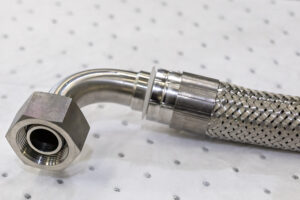
The protective external overbraid is fitted over the hydraulic hose during assembly.
The stainless steel braid is supplied as a flexible woven sleeve in a range of sizes from 15mm to 80mm internal diameter.
The hose assembler:
- measures the hose length,
- cuts the braid slightly longer than the hose,
- and tapes or binds the cut ends to prevent fraying.
The braid is then slightly expanded and fed over the hose.
Depending on the hose size and stiffness:
- the hose may be lightly lubricated,
- compressed air may be used to expand the braid,
- or a mandrel or feeding tool may be used.
Once released, the braid contracts around the hose.
The end fittings are crimped onto the hose, with metal collars positioned over the braid ends.
The braid ends must be prevented from:
- fraying,
- slipping,
- or creating a wire-brush effect.
After the end fittings are crimped to size, the metal collars are crimped over the braid ends.
The finished assembly is checked for:
- exposed sharp wires,
- braid movement,
- fitting clearance,
- restricted bending,
- and pressure integrity.
Hydraulic assemblies, with stainless steel protective overbraid, are often pressure-tested after assembly for safety and quality assurance.
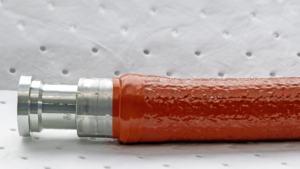
Aerostyle Grade Pyrojacket
Thicker, denser inner glass fibre than our Industrial grade gives higher insulation values, increased strength and enhanced abrasion resistance.
Sheds splash immediately.
ADL Insulflex Aerostyle Pyrojacket® withstands repeated exposures to molten steel, aluminium & glass up to 1650°C. The heavy coating of iron oxide red silicone rubber compound sheds molten metal splash immediately, so very little heat transfer occurs.
Withstands intense radiant heat and flame.
Aerostyle Pyrojacket® will withstand continuous exposure to 260°C; up to 1090°C for 15-20 minutes; and up to 1650°C for 15-30 seconds.
When exposed to flames, the silicone rubber transforms into a crust, creating a protective SiO2 refractory layer.
Aerostyle Pyrojacket® is constructed from high bulk glass fibre braided sleeve. Excellent modulus of elasticity makes it an ideal choice for bundling hoses, tubes and cables in a variety of hostile environments.
